

Hainish Cycle
8 books
The Hainish Cycle series by Ursula K. Le Guin has 8 books. Start with Rocannon's World (1966), then read the rest in the order below.
Hainish Cycle reading order
Rocannon's World
Ursula K. Le Guin
Embark on an interstellar adventure in Ursula K. Le Guin's debut novel, a foundational work in her acclaimed Hainish Cycle. This tale follows Rocannon, an exiled nobleman from a technologically advanced world, as he journeys to a primitive planet in search of a lost artifact. His quest becomes a thrilling exploration of alien cultures, ancient mysteries, and the clash between advanced civilizations and nascent societies. Le Guin masterfully weaves a narrative that, while an exciting adventure, also begins to explore the profound themes of cultural difference and the human condition that would define her later masterpieces.
Planet of Exile
Ursula K. Le Guin
On the planet Werel, a human colony has been stranded for generations, their existence intertwined with the planet's harsh, long winters. During these extended cold spells, they encounter the nomadic Hilfs, a people who view the humans with fear and suspicion, calling them 'farborns.' As an aggressive enemy approaches from the south, threatening both peoples, a young woman from the colony and a native Hilf must bridge the chasm of misunderstanding between their cultures. Ursula K. Le Guin masterfully explores themes of cultural difference, prejudice, and the potential for connection in the face of shared adversity, weaving a compelling narrative of survival and understanding.
City of Illusions
Ursula K. Le Guin
In a far-flung future shaped by the League of Worlds, a lone outsider with amber eyes arrives on Earth carrying both hope and suspicion. As a lie-tormented humanity teeters under the threat of conquest, he must prove—again and again—that he is not a tool of the enemy, even while the world around him refuses to make sense. Following a westward trek through shifting cultures and unsettling encounters, he moves from survival to understanding, where the real battle becomes the search for truth and the work of self-knowledge. With Ursula K. Le Guin’s distinctive, adult-minded science fiction—part adventure, part psychological and semi-mystical inquiry—this novel explores illusion versus reality, the ethics of trust, and what it means to see clearly when everything you’ve been told is breaking apart.
The Left Hand of Darkness
Ursula K. Le Guin
Genly Ai, an envoy from the Ekumen, arrives on the planet Gethen with a mission to unite its scattered nations into a galactic confederation. He finds himself on a world of ambisexual beings, where individuals are neither male nor female, but can adopt either sex during their monthly estrus. Navigating the complex political landscape and the deeply ingrained cultural differences, Genly must learn to understand and trust the Gethenians, particularly the enigmatic Estraven, a disgraced former minister. This groundbreaking novel explores themes of gender, identity, communication, and the challenges of forging connections across profound cultural and biological divides.
The Word for World Is Forest
Ursula K. Le Guin
On the forest planet Athshe, humans arrive to strip the land for profit, only to find themselves entangled in a brutal cycle of conquest and resistance. As Captain Don Davidson’s camp tightens its grip and the enslaved Athsheans endure, a lone survivor’s journey through the woods reveals how language, memory, and belief can become weapons—and how dreams can carry the seeds of change. Ursula K. Le Guin’s spare, lyrical science fiction turns the familiar machinery of empire into a moral reckoning, exploring colonialism, ecological exploitation, and the thin line between survival and complicity. With its haunting empathy and quietly devastating reversals, this novella asks what it means to “know” another people—and what it costs to refuse them their own world.
The Dispossessed
Ursula K. Le Guin
Shevek, a brilliant physicist, lives on Anarres, an arid moon settled two centuries ago by anarchist exiles who built a society without government, property, or law. When his work on a revolutionary theory of time is stifled by the conformity creeping into his supposedly free world, he makes an unprecedented choice: he travels to Urras, the wealthy, capitalist mother planet his people fled. There he is feted, courted, and watched, and forced to confront the promise and failures of both worlds. Le Guin's "ambiguous utopia" is a profound exploration of freedom, solidarity, and the walls, visible and invisible, that societies build around themselves.
Four Ways to Forgiveness
Ursula K. Le Guin
Ursula K. Le Guin's "Four Ways to Forgiveness" invites readers to a distant future where two worlds, seeded by ancient explorers, grapple with their shared history and the arduous path to reconciliation. This collection of interconnected tales masterfully explores the profound and often challenging nature of forgiveness, examining its personal and political ramifications. Through Le Guin's signature elegant prose, witness escalating tensions and acts of violence that test the human capacity for both cruelty and compassion, ultimately leading toward a complex understanding of liberation and identity.
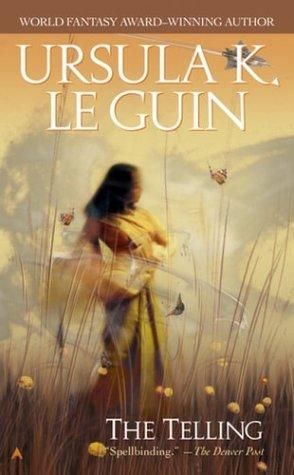
The Telling
Ursula K. Le Guin
On the technologically advanced world of Aka, an ancient tradition known as "The Telling" is being systematically suppressed. Sutty, a Terran envoy, arrives with a mission to study this unique culture, only to find herself caught in the crossfire between progress and preservation. As she delves deeper into the heart of Aka's society, Sutty must navigate a complex web of beliefs, political intrigue, and the profound human need for meaning. This novel explores the enduring power of tradition, the seductive nature of technological advancement, and the universal quest for spiritual understanding.